
Vaccination Modeling Approaches#
This tutorial demonstrates three approaches for modeling vaccination in laser-measles and explains when to use each one.
Key insight: The mcv1 scenario parameter only vaccinates newborns through the VitalDynamicsProcess. It does not immunize the existing population. In short simulations (< 5 years), this produces negligible population-level immunity changes. To model a population that has already been partially vaccinated, you need a different approach.
The three approaches covered here are:
Pre-existing immunity — Set initial S/R split to reflect historical vaccination
Routine immunization (MCV1) — Vaccinate newborns over a long simulation
SIA campaigns — Discrete supplementary immunization activities
We use the compartmental model (daily timesteps) for all examples.
Setup#
We create a simple single-patch scenario and define helper functions for running models and plotting results.
[1]:
import matplotlib.pyplot as plt
import numpy as np

from laser.measles.compartmental import BaseScenario
from laser.measles.compartmental import CompartmentalParams
from laser.measles.compartmental import Model
from laser.measles.compartmental import components
from laser.measles.components import create_component
from laser.measles.scenarios import synthetic
Approach 1: Pre-existing immunity#
The fastest way to model a population with historical vaccination coverage is to adjust the initial S/R split. The InitializeEquilibriumStatesProcess does this using the endemic equilibrium formula:
A higher R0 means more of the population starts in the Recovered (immune) compartment. This is the recommended approach for outbreak scenario analysis where you want to explore “what if X% of the population is already immune?”
Below we compare four coverage levels by varying the effective R0 parameter of InitializeEquilibriumStatesProcess.
[2]:
years = 3
num_ticks = years * 365

# We will run models with different levels of pre-existing immunity.
# Higher R0 -> more initial immunity -> fewer susceptibles at t=0.
# R0=1.0 means 100% susceptible (no pre-existing immunity).
r0_values = {"No immunity (R0=1)": 1.0, "Low immunity (R0=4)": 4.0, "Moderate immunity (R0=8)": 8.0, "High immunity (R0=16)": 16.0}

results = {}
for label, r0 in r0_values.items():
    scenario = synthetic.single_patch_scenario(population=500_000, mcv1_coverage=0.0)
    params = CompartmentalParams(num_ticks=num_ticks, seed=42, start_time="2000-01")

    model = Model(scenario, params, name="preexisting_immunity")
    init_params = components.InitializeEquilibriumStatesParams(R0=r0)
    infection_params = components.InfectionParams(seasonality=0.15)
    model.components = [
        create_component(components.InitializeEquilibriumStatesProcess, params=init_params),
        components.ImportationPressureProcess,
        create_component(components.InfectionProcess, params=infection_params),
        components.VitalDynamicsProcess,
        components.StateTracker,
    ]
    model.run()

    tracker = model.get_instance("StateTracker")[0]
    results[label] = {
        "S": tracker.S.copy(),
        "I": tracker.I.copy(),
        "initial_susceptible_frac": tracker.S[0] / scenario["pop"].sum(),
    }
|████████████████████████████████████████| 1095/1095 [100%] in 0.3s (3226.09/s)
|████████████████████████████████████████| 1095/1095 [100%] in 0.3s (3202.47/s)
|████████████████████████████████████████| 1095/1095 [100%] in 0.3s (3214.90/s)
|████████████████████████████████████████| 1095/1095 [100%] in 0.3s (3262.96/s)
[3]:
fig, axes = plt.subplots(1, 2, figsize=(14, 5))

time_days = np.arange(num_ticks)
for label, data in results.items():
    frac = data["initial_susceptible_frac"]
    axes[0].plot(time_days / 365, data["I"], label=f"{label} (S0={frac:.0%})")
    axes[1].plot(time_days / 365, data["S"], label=f"{label} (S0={frac:.0%})")

axes[0].set_xlabel("Time (years)")
axes[0].set_ylabel("Infectious")
axes[0].set_title("Epidemic Curve by Pre-existing Immunity Level")
axes[0].legend(fontsize=8)
axes[0].grid(True, alpha=0.3)

axes[1].set_xlabel("Time (years)")
axes[1].set_ylabel("Susceptible")
axes[1].set_title("Susceptible Population Over Time")
axes[1].legend(fontsize=8)
axes[1].grid(True, alpha=0.3)

plt.tight_layout()
plt.show()
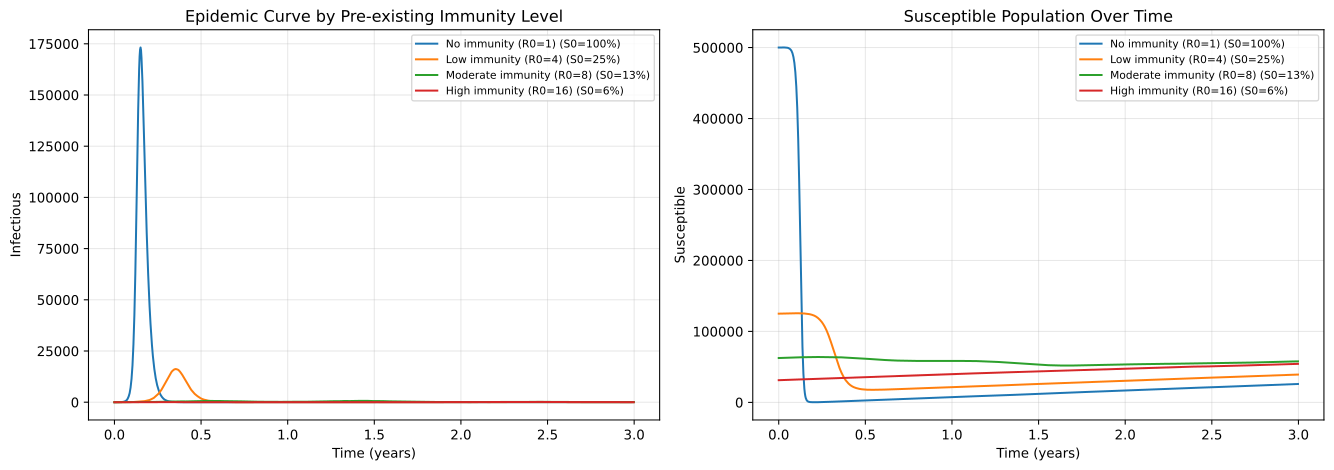
Notice the dramatic difference: with no pre-existing immunity the entire population experiences a large epidemic, while with high immunity (R0=16, ~94% initially immune) outbreaks are small and quickly contained.
Approach 2: Routine immunization (MCV1)#
The mcv1 scenario parameter works through VitalDynamicsProcess to vaccinate a fraction of newborns at each tick. This is the correct way to model an ongoing routine immunization program.
Important: Because only newborns are vaccinated, the effect on population-level susceptibility builds up very slowly. You need long simulations (10-20+ years) to see meaningful impact. In a 2-3 year simulation, even 95% MCV1 coverage will barely change the susceptible fraction.
Below we run a 20-year simulation comparing 0% vs 80% MCV1 coverage.
[4]:
years_long = 20
num_ticks_long = years_long * 365

mcv1_levels = {"MCV1 = 0%": 0.0, "MCV1 = 80%": 0.80}

results_routine = {}
for label, mcv1_cov in mcv1_levels.items():
    scenario = synthetic.single_patch_scenario(population=500_000, mcv1_coverage=mcv1_cov)
    params = CompartmentalParams(num_ticks=num_ticks_long, seed=42, start_time="2000-01")

    model = Model(scenario, params, name="routine_immunization")
    infection_params = components.InfectionParams(seasonality=0.15)
    model.components = [
        components.InitializeEquilibriumStatesProcess,
        components.ImportationPressureProcess,
        create_component(components.InfectionProcess, params=infection_params),
        components.VitalDynamicsProcess,
        components.StateTracker,
    ]
    model.run()

    tracker = model.get_instance("StateTracker")[0]
    total_pop = tracker.state_tracker.sum(axis=0).flatten()
    results_routine[label] = {
        "S_frac": tracker.S / total_pop,
        "I": tracker.I.copy(),
    }
|████████████████████████████████████████| 7300/7300 [100%] in 2.3s (3210.64/s)
|████████████████████████████████████████| 7300/7300 [100%] in 2.3s (3191.91/s)
[5]:
fig, axes = plt.subplots(1, 2, figsize=(14, 5))

time_days = np.arange(num_ticks_long)
for label, data in results_routine.items():
    axes[0].plot(time_days / 365, data["I"], label=label)
    axes[1].plot(time_days / 365, data["S_frac"], label=label)

axes[0].set_xlabel("Time (years)")
axes[0].set_ylabel("Infectious")
axes[0].set_title("Epidemic Curve: Routine Immunization (20 years)")
axes[0].legend()
axes[0].grid(True, alpha=0.3)

axes[1].set_xlabel("Time (years)")
axes[1].set_ylabel("Susceptible Fraction")
axes[1].set_title("Susceptible Fraction Over Time")
axes[1].legend()
axes[1].grid(True, alpha=0.3)

plt.tight_layout()
plt.show()
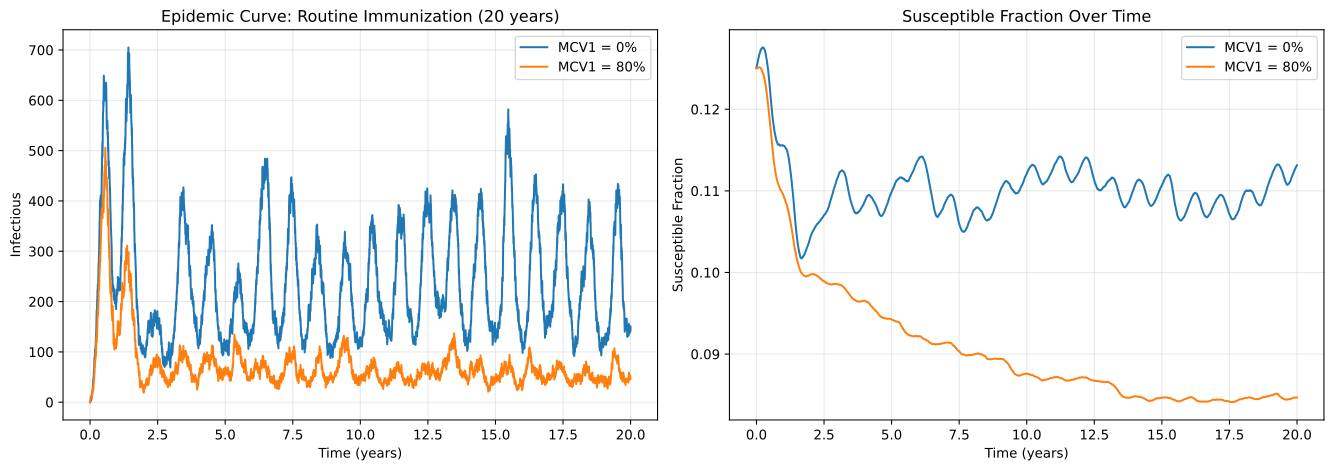
Over 20 years, the 80% MCV1 coverage gradually reduces the susceptible fraction compared to 0% coverage. The effect is cumulative as vaccinated cohorts replace unvaccinated ones, but note how long it takes to see a substantial difference. This is why mcv1 alone is not sufficient for modeling short-term outbreak scenarios with pre-existing immunity.
Approach 3: SIA campaigns#
SIACalendarProcess implements discrete supplementary immunization activities (SIAs) that vaccinate a fraction of the existing susceptible population at specific dates. This models mass vaccination campaigns.
Below we schedule two SIA campaigns and show their effect on the susceptible population.
[6]:
import polars as pl

years_sia = 5
num_ticks_sia = years_sia * 365

scenario = synthetic.single_patch_scenario(population=500_000, mcv1_coverage=0.0)
params = CompartmentalParams(num_ticks=num_ticks_sia, seed=42, start_time="2000-01")

# Define SIA schedule: two campaigns
sia_schedule = pl.DataFrame(
    {
        "id": ["patch_1", "patch_1"],
        "date": ["2001-06-15", "2003-06-15"],
    }
)

sia_params = components.SIACalendarParams(
    sia_schedule=sia_schedule,
    sia_efficacy=0.9,
    aggregation_level=1,
)

model = Model(scenario, params, name="sia_campaigns")
infection_params = components.InfectionParams(seasonality=0.15)
model.components = [
    components.InitializeEquilibriumStatesProcess,
    components.ImportationPressureProcess,
    create_component(components.InfectionProcess, params=infection_params),
    components.VitalDynamicsProcess,
    create_component(components.SIACalendarProcess, params=sia_params),
    components.StateTracker,
]
model.run()

tracker = model.get_instance("StateTracker")[0]
|████████████████████████████████████████| 1825/1825 [100%] in 1.1s (1717.12/s)
[7]:
fig, axes = plt.subplots(1, 2, figsize=(14, 5))

time_days = np.arange(num_ticks_sia)
axes[0].plot(time_days / 365, tracker.I, color="red")
axes[0].set_xlabel("Time (years)")
axes[0].set_ylabel("Infectious")
axes[0].set_title("Epidemic Curve with SIA Campaigns")
for year in [1.5, 3.5]:
    axes[0].axvline(x=year, color="green", linestyle="--", alpha=0.7, label="SIA" if year == 1.5 else None)
axes[0].legend()
axes[0].grid(True, alpha=0.3)

total_pop = tracker.state_tracker.sum(axis=0).flatten()
axes[1].plot(time_days / 365, tracker.S / total_pop, color="blue")
axes[1].set_xlabel("Time (years)")
axes[1].set_ylabel("Susceptible Fraction")
axes[1].set_title("Susceptible Fraction with SIA Campaigns")
for year in [1.5, 3.5]:
    axes[1].axvline(x=year, color="green", linestyle="--", alpha=0.7, label="SIA" if year == 1.5 else None)
axes[1].legend()
axes[1].grid(True, alpha=0.3)

plt.tight_layout()
plt.show()
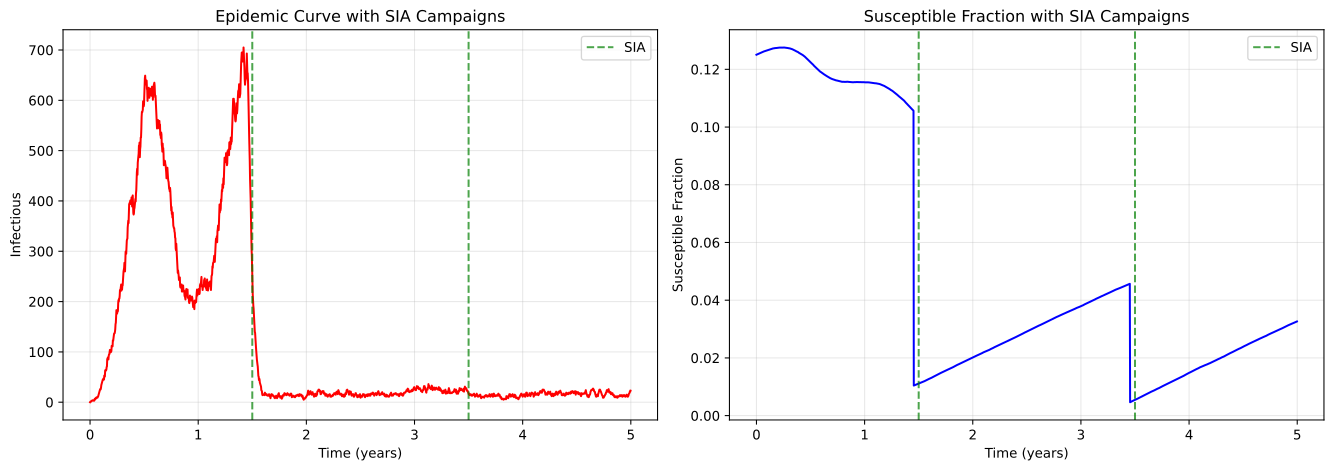
The SIA campaigns produce sharp drops in the susceptible population at the scheduled dates, providing immediate population-level immunity.
Decision Matrix#
Goal |
Approach |
Component |
Timescale |
|---|---|---|---|
Model pre-existing population immunity |
Set initial S/R split |
|
Immediate (t=0) |
Model ongoing routine immunization program |
Vaccinate newborns via |
|
Long-term (10-20+ years) |
Model mass vaccination campaigns |
Vaccinate existing susceptibles on specific dates |
|
Discrete events |
Combine approaches |
Use all three together |
All of the above |
Mixed |
Common pitfall: Setting mcv1=0.95 and expecting 95% of the population to be immune in a 2-year simulation. The mcv1 parameter only vaccinates newborns — use Approach 1 or 3 for immediate population-level immunity.